LONG TERM OUT OF STOCK
SOLD OUT
OUT OF STOCK
AVAILABLE SPRING
AVAILABLE SUMMER
AVAILABLE AUTUMN
AVAILABLE WINTER
WINTER DORMANT
AVAILABLE SOON
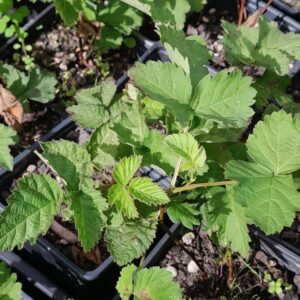
Black Satin blackberries are perennial plants which bear thornless upright biennial canes which grow up direct from the roots. In late spring pinkish-white flowers appear on the tips of branches. These are followed in mid-late summer by large black fruit with a sweet flavour – sweeter than thorny varieties. Black Satin is a vigorous grower that establishes quickly, produces heavy yields, and requires trellising. It tolerates more heat than some other varieties. Plants are self-fertile and pollinated by bees.
Blackberries are hybrids between individual species in the Rubus subgenus Rubus, and also between the subgenera Rubus and Idaeobatus. Confused?! Don’t worry, basically the term blackberry can refer to many related species which hybridise! Wild species are thorny but many thornless varieties have been bred since the 1920s, including this one.
9cm pot
Blackberries can cope with very average or poor soil, but prefer well-drained soil with adequate moisture and levels of organic matter. They can tolerate full sun or part shade and prefer some protection from wind. They will need watering through dry spells.
The stems or canes go through a two year cycle. In the first year, a new stem, the ‘primocane’, reaches a height of 1.5 metres or more and produces leaves but not flowers. In late summer – early autumn, prune off 10cm of the terminal growth of the canes to help initiate the production of fruiting spurs the next year. In the second year, this cane is a known as a ‘floricane’, and the lateral buds open to produce flowering laterals. After these canes have fruited they should be pruned off right from the base, in autumn or winter. All strong canes produced in spring and summer should be tied up, and thin, weak canes, or ones heading into your pathways should be pruned off.
Blackberries have been used medicinally by many cultures, including the Greeks, Northern Europeans and Native Americans. Blackberry leaf contains tannins which can soothe the gut and treat diarrhoea and mild inflammation. The astringent, anti-inflammatory and antibacterial effects make it ideal for sore throats, oral thrush, mouth ulcers, and bleeding gums. They can also help reduce heavy menstrual flow and ease cramping, and treat skin conditions such as eczema, psoriasis, and acne. Blackberry root has a stronger astringent effect than the leaves.
Both berries and leaves are rich in vitamin C and antioxidants that support the immune system and reduce inflammation. The berries are also rich in polyphenols, which may have antiviral properties.
Blackberries contain numerous seeds which are rich in omega-3 and omega-6 fatty acids.
Primary Actions: astringent, anti-inflammatory, antibacterial, antiviral, antioxidant
Parts Used: leaf, root, berry
N.B. Shipping costs are added AFTER you have placed your order, you will then be emailed an invoice with bank details.
Smallest box rate:
This can fit up to 9 plants in 9cm pots.
Shipping a single tree can be expensive. We may be able to fit more in the box for the same price! See our shipping rates for single and multi tree boxes.
Combining sizes?
No problem, we will work out the best rate for you once you’ve placed your order.
Jo has a passion for growing herbs but is not a qualified herbalist and has no medical background.
We are lucky to have Patricia Beagle working here at times, who is qualified, and some of her advice does appear on these pages, but herbs act differently for different people and can interact with other medicines. We therefore always recommend that you consult with your own qualified health-care practitioner before using herbal products, particularly if you are pregnant, nursing or on any medications.
Kahikatea Farm cannot take any responsibility for any adverse effects from the use of the plants or a plant not having the effect it is reputed to have.